
The Complete Guide to Pet Stroller Types: Which One Fits Your Brand?
Published 07 September 2026 · 10 min read · Pet Stroller OEM Editorial
A pet stroller type is not just a shape — it is a use-case, a price point, and a customer segment wrapped into one product decision. Choose the wrong type for your target market and you will sit on inventory that Amazon returns at 15% per month. Choose the right one and you own a category niche that competitors cannot easily copy because their factory's tooling is set up for something else. This guide breaks down every major pet stroller type, who buys each one, what it costs to manufacture, and how to match type selection to your private-label brand strategy.
The Five Core Pet Stroller Types
Grand View Research estimates the global pet stroller and carrier market exceeded USD 1.2 billion in 2024 and is growing at roughly 7% CAGR through 2030. Within that market, five distinct product categories dominate retail shelves and e-commerce listings. Understanding each category's engineering requirements, target buyer profile, and typical FOB price band is the first step in building a coherent private-label product line.
Type 1: Standard Four-Wheel Pet Strollers
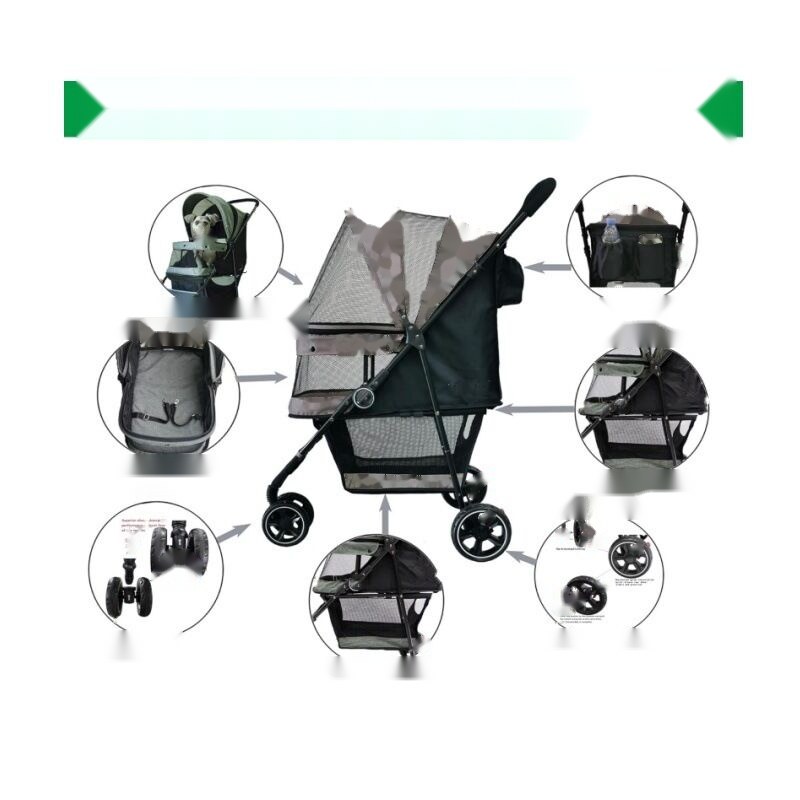
The four-wheel stroller is the default SKU for first-time importers and accounts for an estimated 55 to 60% of global pet stroller shipments. It uses a rectangular or slightly trapezoidal frame with four wheels (two fixed rear, two swiveling front), a cabin height of 16 to 22 inches, and a total weight of 12 to 22 lbs depending on materials. The cabin is usually enclosed with 600D or 900D Oxford polyester, mesh windows on three sides, and a zippered canopy that folds back or removes entirely.
Why it sells: Stability on sidewalks, mall floors, and vet clinic waiting rooms. Senior pet owners and small-breed owners (cats, Chihuahuas, French Bulldogs) prioritize ease of pushing over terrain capability. The four-point contact means the stroller does not tip when the pet shifts weight to one side — a real concern with anxious cats.
- Typical FOB range: USD 12 – 28 per unit (MOQ 300–1,000)
- Frame: Steel tube (entry) or aluminum alloy (mid-to-premium)
- Fabric: 600D Oxford (standard) or 900D Oxford with waterproof coating (premium)
- Wheels: 5–6 inch EVA foam (standard) or 7–8 inch air-filled PU (upgrade)
- Weight capacity: 15 – 25 kg (33 – 55 lbs)
- Ideal for: Cats, small dogs, senior pets, urban commuting
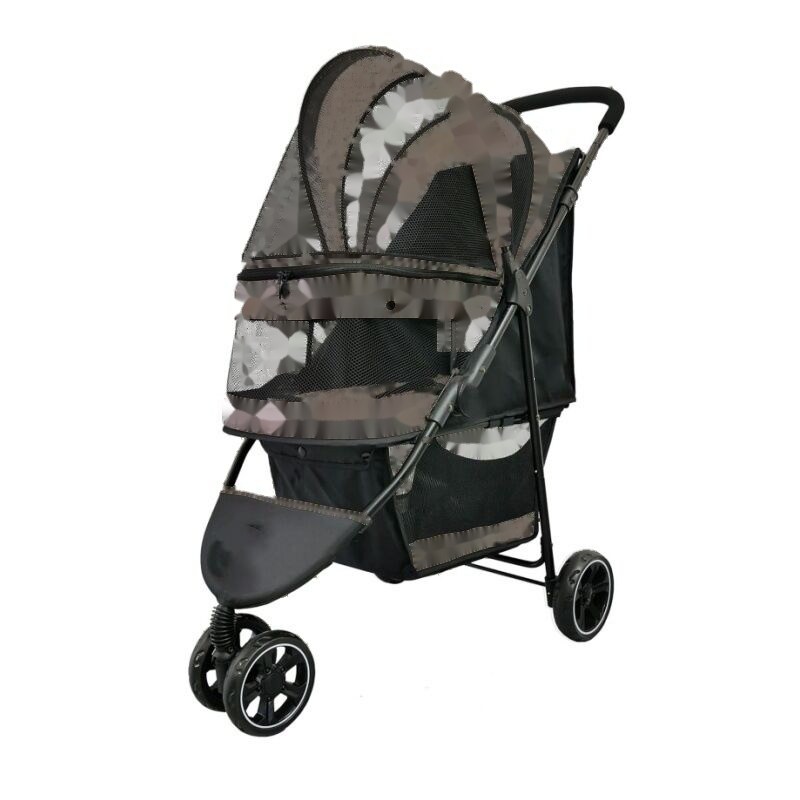
Type 2: Three-Wheel Jogging Pet Strollers
The jogging stroller swaps the dual front wheels for a single larger swiveling wheel (typically 8–12 inches) positioned ahead of the frame. This geometry reduces turning radius by 30 to 40% compared to a four-wheel model and allows the front wheel to roll over small obstacles — curbs, tree roots, gravel paths — without jamming. The trade-off is lateral stability: a three-wheel stroller is more likely to tip if pushed sideways on a slope, so joggers usually include a wrist strap and a wider rear axle.
Who buys these: Active dog owners (medium breeds: Beagles, Corgis, Border Collies) who walk or jog on mixed terrain. In North America and Northern Europe, jogging strollers represent 15 to 20% of the pet stroller market. They command a 20 to 35% price premium over equivalent four-wheel models because the front suspension fork and larger wheel assembly add material and welding cost.
- Typical FOB range: USD 18 – 38 per unit
- Frame: Aluminum alloy (steel is too heavy for jogging use)
- Front wheel: 8–12 inch air-filled or solid-rubber with suspension
- Rear wheels: 8–10 inch, fixed or lightly damped
- Weight capacity: 20 – 35 kg (44 – 77 lbs)
- Ideal for: Medium dogs, trail walking, park jogging, active lifestyles
Type 3: Double / Twin Pet Strollers
Twin strollers accommodate two pets simultaneously. The two most common layouts are side-by-side (two cabins next to each other, like a twin baby stroller) and front-to-back (a narrower footprint with one pet seated ahead of the other). Side-by-side offers equal visibility and prevents squabbles but requires a wider door frame (28–34 inches total width). Front-to-back fits through standard doors but the rear pet has a restricted forward view.
OEM considerations: Twin strollers need a reinforced cross-member between the two cabin frames, stronger rear axle bearings, and roughly 40% more fabric per unit. MOQ for twin models is often higher (500–1,000 units) because the tooling amortization is spread across fewer SKUs than single strollers. Despite the higher unit cost, twin strollers carry strong margins in markets where multi-pet households are common (US, UK, Germany, Japan).
- Typical FOB range: USD 25 – 50 per unit
- Layouts: Side-by-side (wide) or tandem/front-to-back (narrow)
- Frame: Steel or aluminum, with central reinforcement bar
- Combined capacity: 30 – 50 kg (two 15–25 kg pets)
- Ideal for: Multi-pet households, breeders, pet daycare transport
Type 4: Large-Dog / Heavy-Duty Pet Strollers
This is the highest-margin and fastest-growing segment in the 2025–2026 product cycle. Large-dog strollers are engineered for pets weighing 30 kg (66 lbs) or more — think Golden Retrievers, German Shepherds, Bull Terriers, and even smaller Great Danes. The frame uses thicker-wall steel tubing (diameter 19–25 mm, wall 1.2–2.0 mm versus 12–16 mm / 0.8–1.2 mm for standard models), wider wheelbase (24–30 inches), and often a low-step entry ramp or a drop-down front panel so the dog can walk in without lifting.
Critical quality checkpoint: Many trading companies sell "large-dog" strollers that are simply resized small-dog frames with thinner tubing. Ask your OEM supplier for a static load test video showing the frame supporting 1.5× the rated capacity for 60 seconds without permanent deformation. If they cannot provide this, you are buying a liability, not a product.
- Typical FOB range: USD 28 – 55 per unit
- Frame: Reinforced steel (aluminum possible but significantly more expensive)
- Cabin interior: 18–24 inches wide × 24–32 inches tall
- Wheels: 8–10 inch EVA or pneumatic, with reinforced hubs
- Weight capacity: 30 – 45 kg (66 – 100 lbs)
- Safety note: Designed and tested with reference to EN 1888 and ASTM F833 structural requirements where applicable
- Ideal for: Large breeds, senior dogs with mobility issues, veterinary transport
Type 5: Foldable & Travel-Friendly Pet Strollers
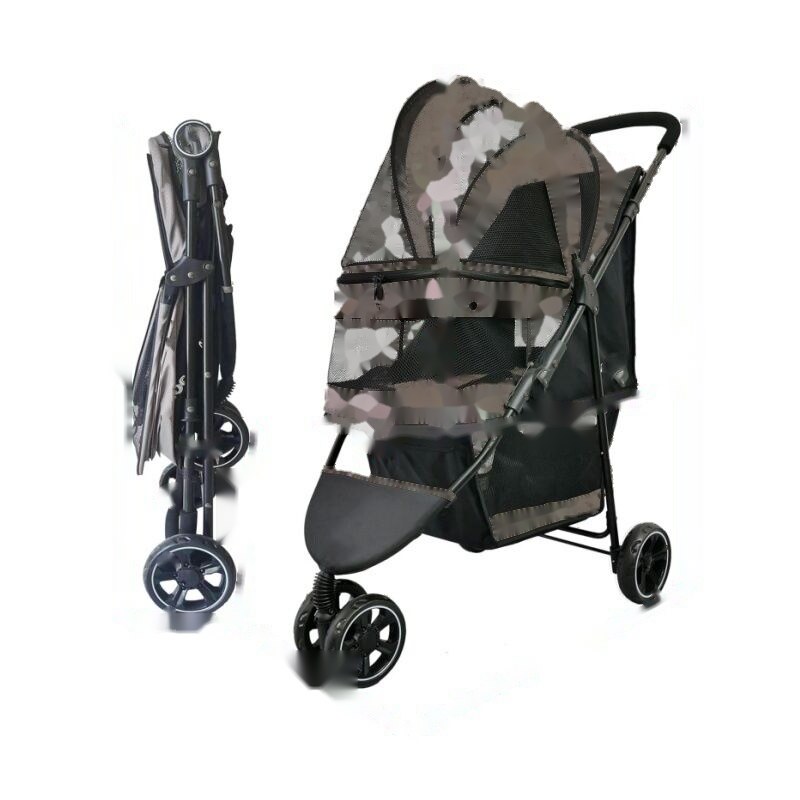
Foldability is no longer a premium feature — it is a baseline expectation in every major market. A travel-friendly pet stroller collapses to under 12 inches thick (some models reach 8 inches) with one hand, locks in the folded position for carrying or car-trunk storage, and reopens without tools. The folding mechanism is the single most failure-prone component in consumer reviews: hinges seize, latches pop open, and plastic joints crack after 50–100 cycles. A reputable OEM supplier will specify a minimum fold-cycle test count (industry benchmark: 3,000 cycles with no functional degradation).
- Typical FOB range: USD 14 – 32 per unit
- Fold mechanism: One-hand umbrella-fold or accordion-fold
- Folded dimensions: Typically 12–16 × 24–30 × 8–12 inches (W×H×D)
- Weight: 9 – 18 lbs (lighter = more premium engineering)
- Ideal for: Travel, car owners, apartment dwellers, airline-compatible SKUs
Comparison Table: Matching Type to Market Segment
Use this table as a quick reference when planning your first or next private-label SKU. The right type depends on who your customer is, where they live, and what they are willing to pay.
| Type | Best Customer | FOB Range (USD) | Capacity | Key Differentiator |
|---|---|---|---|---|
| 4-Wheel Standard | Cat / small-dog owners, seniors, urban | $12 – $28 | 15–25 kg | Stability, lowest entry price |
| 3-Wheel Jogger | Active medium-dog owners, trail walkers | $18 – $38 | 20–35 kg | Terrain handling, sporty look |
| Double / Twin | Multi-pet households, breeders | $25 – $50 | 30–50 kg | Two pets, higher margin |
| Large-Dog / Heavy-Duty | Big-breed owners, vet clinics | $28 – $55 | 30–45 kg | Reinforced frame, high capacity |
| Foldable / Travel | Travelers, car owners, apartments | $14 – $32 | 15–25 kg | Compact fold, portability |
How to Choose the Right Type for Your Private-Label Brand
If you are launching your first pet stroller line, start with one type and master it before expanding. The safest entry point is the four-wheel standard stroller in aluminum alloy with 900D Oxford fabric and 6-inch EVA wheels — it covers the largest addressable market, has the most predictable supply chain, and leaves room to add color variants and accessory bundles as you learn your customers' preferences. Once you have established distribution and gathered 90 days of sales data, introduce a second type based on what your customer feedback reveals: if buyers ask about bigger dogs, add a large-dog SKU; if they mention jogging trails, add a jogger.
A pet stroller OEM manufacturer worth working with will support this staged rollout by keeping common components (wheels, zippers, cup-holder brackets) in stock while swapping frame geometries and fabric patterns per order. If your supplier insists on a 1,000-unit minimum for every new type, you are dealing with a factory that lacks flexible tooling — a red flag for a brand that plans to grow.
Conclusion: Type Selection Is a Strategic Decision, Not a Design Preference
The pet stroller type you choose determines your supply chain complexity, your warranty return rate, and your position on Amazon's search results page. Start with data — look at what is selling in your target market, read the negative reviews on competing products (those reveal unmet needs), and pick one type that fills a gap rather than crowding an already-saturated slot. Then find an OEM partner who can manufacture that type in-house, test it properly, and scale with you from 500 to 5,000 units without dropping quality.
Get a Free Quote & Sample Timeline
We respond within 24 hours on working days. Sample lead time 7 to 15 days. Bulk MOQ from 300 units per color. Custom frame, fabric, and logo options available.
Frequently Asked Questions
What are the main types of pet strollers?
The five main categories are: standard four-wheel strollers (most common, stable on flat surfaces), three-wheel jogging strollers (larger front wheel for uneven terrain), double or twin strollers (two cabins side by side or stacked), large-dog or heavy-duty strollers (reinforced frame, 30–100 lb capacity), and foldable travel strollers (compact, one-hand fold). Each serves a distinct use case and price segment.
Which pet stroller type is best for large dogs?
Large-dog strollers are purpose-built with reinforced steel or aluminum frames, wider cabins (18–24 inches), and load ratings of 30 kg to 45 kg (66–100 lbs). Look for models with at least 6-inch rear wheels, a low center of gravity, and a non-slip floor mat. A standard cat-sized stroller will fail under a 40-lb dog within weeks.
What is the difference between a 3-wheel and 4-wheel pet stroller?
A 4-wheel stroller offers superior stability on pavement, shopping malls, and indoor spaces — ideal for urban commuters and senior pets. A 3-wheel jogging stroller trades some stability for maneuverability: the single swiveling front wheel handles grass, gravel, and light trails better, making it the choice for active owners who jog or walk off-road. For OEM buyers, 4-wheel models outsell 3-wheel roughly 3:1 in most markets.
Can a pet stroller OEM manufacturer produce all five types?
Yes, but not all factories can do it well. A legitimate pet stroller OEM should have separate tooling and welding lines for each frame geometry (jogger vs. standard vs. heavy-duty). Ask your supplier to show you their current production mix — if they only make one type, they are likely reselling someone else's designs rather than manufacturing in-house.
How much does a custom pet stroller cost per unit at MOQ 500?
At 500 units per color, FOB pricing typically ranges from USD 15 to 35 per unit depending on frame material (steel vs. aluminum alloy), fabric grade (600D vs. 900D Oxford), wheel type (EVA foam vs. air-filled PU), and accessory count. Large-dog models run 20–30% higher due to reinforced tubing and heavier-duty joints.
Related reads: 3-Wheel vs 4-Wheel Pet Stroller Comparison · Aluminum vs Steel Frame Guide · OEM & ODM Services · Get a Quote